
-
Cellulose Mordant Studio Kit
Vendor:themaziRegular price $72.90 USDRegular price -
Soda Ash (Sodium Carbonate)
Vendor:themaziRegular price From $5.00 USDRegular price -
White Oak Gall Powder
Vendor:themaziRegular price From $12.00 USDRegular price -
White Oak Galls (Whole)
Vendor:themaziRegular price From $11.00 USDRegular price -
Sumac Leaf Powder
Vendor:themaziRegular price From $10.00 USDRegular price -
Pomegranate Peel Powder
Vendor:themaziRegular price From $12.00 USDRegular price -
Alum Mordant
Vendor:themaziRegular price From $7.90 USDRegular price -
Calcium Carbonate
Vendor:themaziRegular price From $5.00 USDRegular price -
Iron (Ferrous Sulphate)
Vendor:themaziRegular price $5.00 USDRegular price -
Madder Extract
Vendor:themaziRegular price From $35.00 USDRegular price -
Madder Root Powder
Vendor:themaziRegular price From $13.00 USDRegular price -
Weld Extract
Vendor:themaziRegular price From $35.00 USDRegular price -
Weld Powder
Vendor:themaziRegular price From $12.00 USDRegular price -
Persian Berry Extract – Turkish Buckthorn
Vendor:themaziRegular price From $38.00 USDRegular price -
Natural Indigo Extract
Vendor:themaziRegular price From $20.00 USDRegular price -
Fructose Powder
Vendor:themaziRegular price From $4.00 USDRegular price -
Black Walnut Hull Powder
Vendor:themaziRegular price From $11.00 USDRegular price -
Red Pine Bark Tannin Extract
Vendor:themaziRegular price From $11.00 USDRegular price -
Acorn Tannin Extract
Vendor:themaziRegular price From $12.00 USDRegular price

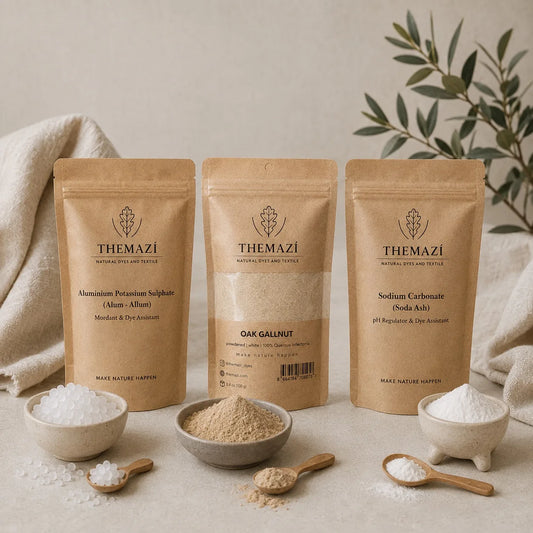




Cotton and linen are plant (cellulose) fibers. They hold natural dyes less easily than wool and silk, so the preparation matters more. This collection brings together everything you need, in the order you use it.
The cotton and linen method
- Scour with soda ash (2–5% WOF) to remove waxes and finishes.
- Tannin with white oak gall or sumac (about 8–10% WOF) for clear colors.
- Alum at 12–15% WOF with a little soda ash, then an optional chalk rinse.
- Dye with madder, weld, buckthorn or indigo.
Want it simple? The Cellulose Mordant Studio Kit has the mordants in one box. Use the WOF calculator to get exact grams for your fabric weight, and read our guide to mordanting cotton and linen.
Need fabric? See undyed fabric by the yard.
Frequently asked questions
Do I need tannin for cotton?
For most dyes, yes. Tannin helps cotton and linen hold the alum mordant, so colors are deeper and more wash-fast. Indigo is the exception: it needs no mordant.
Which natural dyes work best on cotton?
Indigo, madder, weld and tannin-rich dyes such as pomegranate and walnut give strong results on cotton and linen.
How much alum for cotton?
After a tannin bath, use 12–15% alum WOF with a little soda ash to neutralize it.
Guides for this collection
-

How to Mordant Cotton and Linen (Cellulose Fibers)
How to mordant cotton and linen for natural dyeing with tannin and alum or with aluminum acetate, with amounts and step-by-step instructions.
How to Mordant Cotton and Linen (Cellulose Fibers)
How to mordant cotton and linen for natural dyeing with tannin and alum or with aluminum acetate, with amounts and step-by-step instructions.
-

Tannin Mordant Guide: Natural Tannins for Dyein...
A practical comparison of natural tannins for dyeing cotton and linen, covering hydrolysable vs condensed tannins, clear vs colored tannins, extracts vs raw materials, and % WOF rates.
Tannin Mordant Guide: Natural Tannins for Dyein...
A practical comparison of natural tannins for dyeing cotton and linen, covering hydrolysable vs condensed tannins, clear vs colored tannins, extracts vs raw materials, and % WOF rates.
-

Soda Ash for Natural Dyeing, Plus Chalk and Gum...
A practical guide to three natural dye assists: soda ash for scouring and alkaline shifts, calcium carbonate for madder, weld and dunging, and gum arabic for mordant printing pastes.
Soda Ash for Natural Dyeing, Plus Chalk and Gum...
A practical guide to three natural dye assists: soda ash for scouring and alkaline shifts, calcium carbonate for madder, weld and dunging, and gum arabic for mordant printing pastes.


